
The Kaizen Funnel is Upside Down: Why "Compliance" is Killing Your Continuous Improvement
I recently caught up with a Continuous Improvement Leader who is three months in to his new role at one of the world’s largest medical technology and life sciences companies. As we talked about the state of continuous improvement at his site, he dropped a line that stood out because I’ve seen this before: "Every single Kaizen that happens here is because someone at a leadership level is telling the team leaders 'thou shalt go run this kaizen'".
On paper, the CI Leader’s Kaizen funnel is full. But in reality, the real friction closest to the customer stays completely untouched.
If you are involved in commercial excellence, you’ve probably seen this exact same pattern in sales and marketing. We call it "Kaizen Compliance".
The Hidden Cost of "Activity"
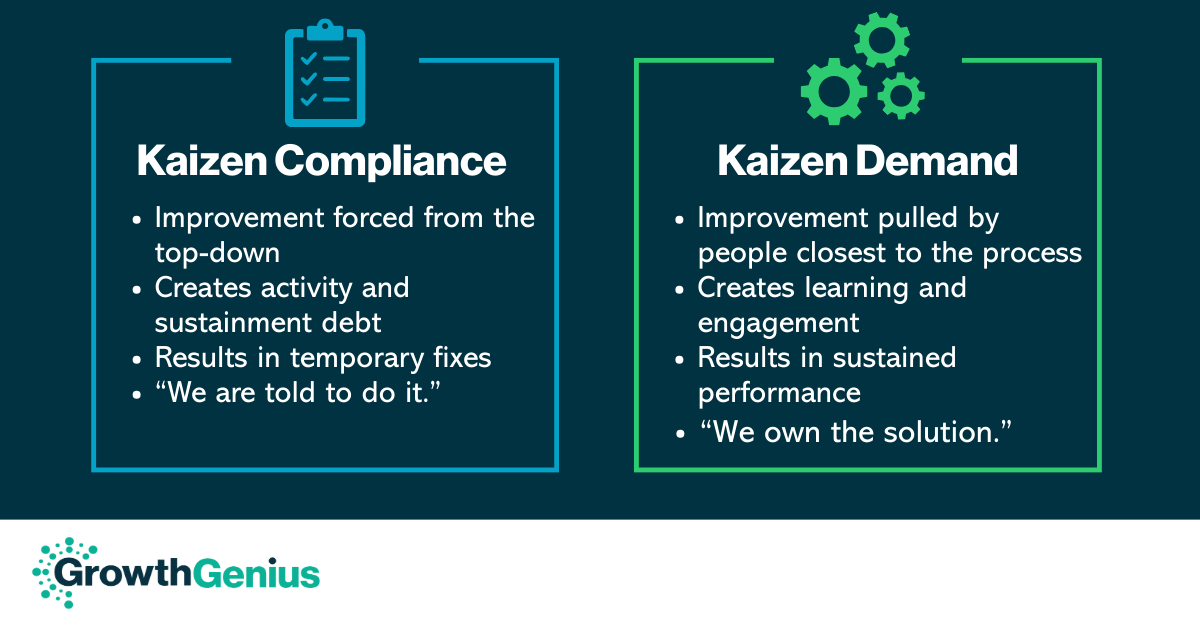
There is a massive distinction between Kaizen Compliance (where improvement work happens because the organization is told to do it) and Kaizen Demand (where the people closest to the process are pulling for change).
Compliance creates activity and fills dashboards, but Demand creates ownership, learning, engagement and sustained performance. When we force improvement from the top, we often end up with "sustainment debt". My friend in med-tech mentioned he was still cleaning up action items from a Kaizen that happened months ago, all while being pressured to prep for the next mandated event. He also mentioned the front-line associates don’t drive continuous improvement efforts because lack of sustainment over-time has caused them to lose buy-in to Kaizen.
When sustainment is weak, trust erodes. And when trust is low, the bottom-up signal goes quiet—leaving leadership to fill the funnel themselves once again.
Why the "Fix" Never Sticks
In commercial organizations, a compliance-driven funnel usually results in projects optimized for visibility rather than impact. An example can be seen in the "Lead Handoff" that never sticks.
Marketing and Sales agree there is a follow-up problem. Leadership identifies the gap and demands a Kaizen focused on lead management. They handpick the participants and roll out new lead stages, a new SLA, and a shiny new dashboard. For two weeks, it looks better. Then, reality returns.
Why? Because the Kaizen was built as a compliance exercise rather than an improvement pulled by the people living the handoff every day. They missed the real root cause(s), like:
Unclear definitions of what a “good” lead actually looks like.
CRM workflows that create so much admin burden that people route around them.
Handoff rules that don’t match how reps actually work their accounts.
Missing feedback loops between Marketing and Sales
A marketing or sales process that isn’t truly centered on the customer
Until the people closest to the work can surface that truth, the handoff stays leaky.
Diagnosing the Silence
Before you can fix the flow, you have to understand why the people closest to the work stopped speaking up. This isn't a guessing game; it requires going to Gemba and potentially running a formal problem-solving process to determine the "Why" behind the silence.
The reasons vary across organizations. Sometimes it's a history of sustainment failures where gains are achieved and then unwound, leading the team to conclude the effort wasn't worth it. We’ve also seen where a “reward” for speaking up just becomes extra work on an already full workload. It also could be a lack of psychological safety, where surfacing a problem feels like surfacing blame, or perhaps the "results" only ever showed up in leadership's metrics and never felt real to the team. In other cases, CI is treated as a "program" rather than a daily practice, making it the first thing to be deprioritized when things get busy.
From Diagnosis to Direction
Once you identify the "Why," you can change the direction of the system. For example, if your problem-solving reveals that the signal died because of Sustainment Debt, the answer isn't to "encourage" more bottom-up ideas. That’s like asking a drowning person to help you carry more water.
In that scenario, a leader might choose to pause all new Kaizen activity for 30 days to focus exclusively on the existing backlog. By clearing the "debt" and proving that improvements will actually stick, you begin to restore the trust necessary for the front line to start sharing their truth again. Or, as my CI Leader friend is doing, they could install a physical Sustainment/Ideation board with a process/cadence that provides visibility, accountability and structure for improved kaizen sustainment. Keep in mind that in getting people from point A to point B, you may need to employ change management best practices.
A More Realistic Path: Bidirectional Flow
While Lean dogma often says the funnel should be filled entirely from the bottom, that can be its own kind of trap. For some organizations, a more realistic way to operate is bidirectional Kaizen flow.
There are many reasons Leaders may identify CI opportunities. They often see constraints through data or customer escalations that teams simply can’t see from their vantage point. In a bidirectional model:
Bottom-up supplies the signal, the truth, and the practical countermeasures.
Top-down sets the intent, removes institutional constraints, and surfaces the opportunities the team might miss.
The goal isn't to choose one stream over the other; it’s making sure one doesn't silence the other.
From Dictating to Partnering
The overarching theme is simple: Leadership needs to work with the frontline to determine the Kaizens.
If leadership has an idea or sees a performance cliff in the data, they shouldn't ignore it—but instead of dictating the solution, ask the team what they think.
Instead of telling a team to "run a Kaizen on lead management," try asking: "We’re generating leads, but conversion is flat. Where do leads die in the handoff, and what’s an experiment we can run this week to test that? What is the data telling us and what ideas do you have? Where are you experiencing friction?”
This provides direction while preserving the front line’s role as the primary sensor for truth. The goal isn't to silence leadership—it's to stop treating Kaizen like a quota.
If you want to know if your system is demand-driven, ask yourself: If we stopped mandating Kaizens for 30 days, would improvement still happen?
