
Your Best People Are Holding Your Business Back
The hidden risk of hero-dependent organizations and how to build something that lasts
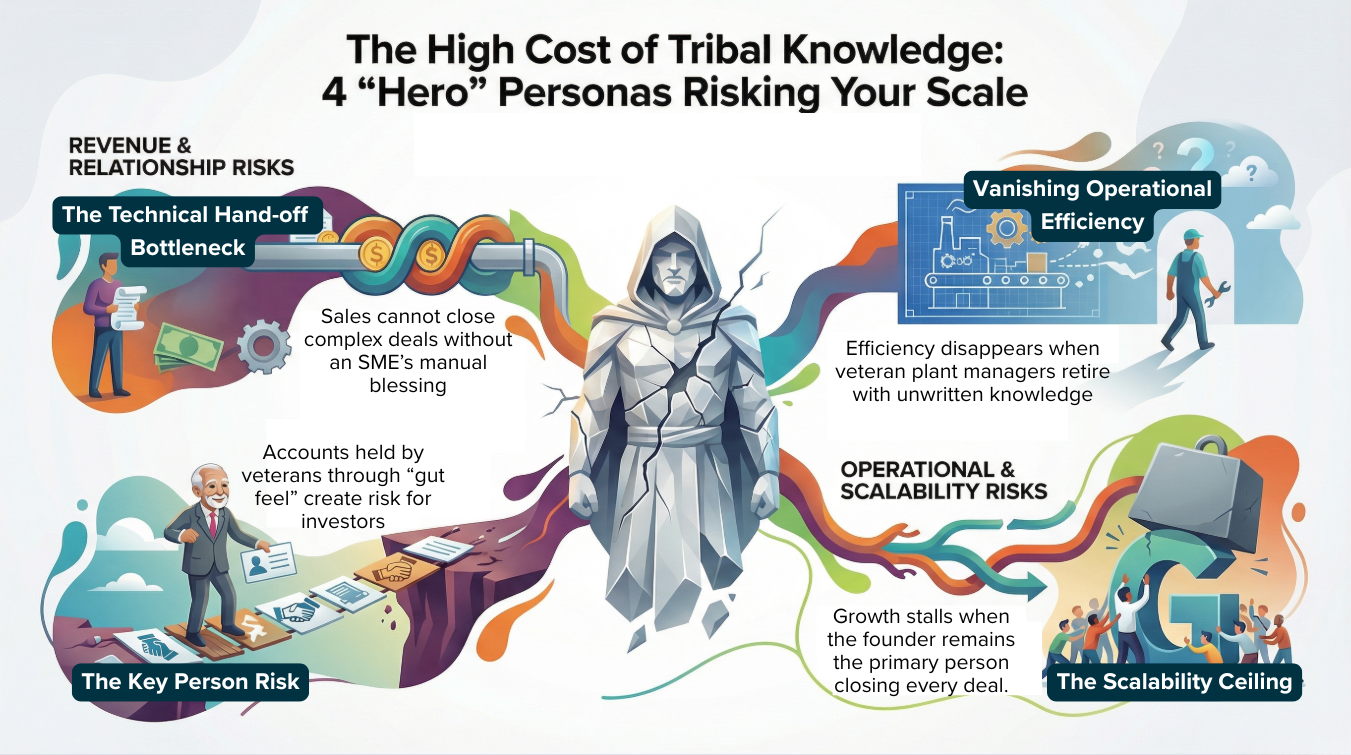
Every commercial organization has them. And you probably know exactly who they are the moment you read this.
Do any of these scenarios exist in your organization?
The veteran sales rep who carries 40% of the quota on relationships alone, whose customer list is basically a personal Rolodex that lives in their head, not your CRM.
The communications marketer who knows the product portfolio like the back of their hand producing sell sheets, campaign briefs, and trade show materials faster than anyone else, but from a process and knowledge that only they understand.
The digital marketer who built the entire MarTech stack, owns every login and workflow, and is the only one who truly understands how any of it fits together.
The product manager who has become the unofficial translator between engineering and sales — deals get done through them, but they have never documented a single process.
The revenue ops person who built every dashboard and report from scratch and is the only one who can fix them when something breaks.
Or the senior leader who is the strategy — every major pricing call, customer escalation, and growth decision running through one desk.
These are your heroes. And they might be some of the greatest risks your business faces.
In the industrial mid-market, where customer relationships are complex, sales cycles are long, and the margin for error is slim, the temptation to rely on standout individuals is enormous. And frankly, in resource-constrained organizations where everyone is already stretched thin, it’s often the easiest option. No one wants to rock the boat, especially when that hero is delivering results. But organizations that grow by depending on heroes aren’t building a commercial engine, they’re building a series of single points of failure. At GrowthGenius, we’ve seen this pattern play out across sales floors, marketing teams, product orgs, and leadership teams alike. The good news: there’s a better way.
What Is Hero-Dependent Growth?
Hero-dependent growth happens when a company’s commercial performance is driven by the exceptional skill, effort, or institutional knowledge of a handful of individuals rather than by structured processes, repeatable playbooks, and shared systems.
Heroes aren’t villains. They’re often your most dedicated, talented people. The problem isn’t the person. It’s the organizational structure that has quietly built itself around them. This is a distinction worth holding onto: the goal is never to diminish individuals, but to build systems strong enough that any capable person can thrive within them.
“The role of management is to change the process rather than badgering individuals to do better.” — W. Edwards Deming
Deming’s insight applies as directly to commercial organizations today as it ever did on the manufacturing floor. When processes are undocumented, inconsistent, or simply don’t exist, the gap gets filled by people — across every function, at every level — and not always by design.
The Real Costs of the Hero Model
Let’s be specific about what hero dependency actually costs your organization across the full commercial team:
Bottlenecks That Quietly Kill Velocity
When deals, content requests, product decisions, or customer escalations route through one or two people, you create choke points across the entire commercial motion. The sales hero is always in the critical path on a key account. The marketing hero is the bottleneck on every asset. The strategy hero must sign off on every meaningful decision. Proposals wait. Campaigns stall. Escalations pile up.
This is what we call “running with the parking brake on.” The organization is technically moving, but burning far more fuel than it should. Research from McKinsey estimates that knowledge workers spend nearly 20% of their time (almost one full day per week) searching for information that already exists somewhere inside the company. That’s time your team is spending hunting, not selling, creating, or serving customers.
Institutional Knowledge That Lives in Someone’s Head
When your best people leave — and eventually, they will — they take the playbook with them. The veteran rep’s customer relationships. The product marketer’s messaging rationale. The digital marketer’s MarTech configuration. The product manager’s unwritten rules between sales and engineering. The data here is stark:
● According to IDC research, Fortune 500 companies lose at least $31.5 billion per year by failing to share knowledge effectively.
● A Panopto study found that a company with just 3,000 employees can expect to lose $8 million annually in productivity due to knowledge-sharing inefficiencies.
● 42% of institutional knowledge lives solely with individual employees and is not shared with colleagues, meaning when that person leaves, nearly half of what they did cannot be done by anyone else on the team.
In the industrial sector, where long-term customer relationships and deep product knowledge are genuine competitive advantages, this loss can be devastating.
Burnout of Your Best People
Heroes don’t just carry the load, they feel it. The sales rep who can never truly hand off an account. The marketer who gets pinged for every asset because no one else knows how to use the templates. The ops person who fields every reporting question because they built the system alone. The constant firefighting, the pressure of being indispensable, the inability to delegate because nothing is documented well enough: this is a recipe for burnout across your entire commercial team.
And the financial impact compounds quickly. Replacing a sales rep alone costs an estimated 1.5 to 2 times their annual salary when you account for recruiting, onboarding, and the revenue gap during the transition. When institutional knowledge evaporates alongside them, SHRM research suggests total replacement costs can climb to 30–200% of the departing employee’s salary — depending on seniority and how undocumented their role was.
A Ceiling on Growth
Hero-driven organizations tend to “think small” not because their people lack ambition, but because the infrastructure isn’t there to support scale. You can’t clone your best rep. You can’t onboard a new marketing hire if the brand voice and campaign process exist only in one person’s head. You can’t expand into new markets if the commercial model lives entirely in the muscle memory of a few individuals.
Consider what happens when you do hire: new sales reps take an average of 3–6 months to reach full productivity — and in complex industrial B2B environments, that window can stretch to 9 months or longer. Organizations with strong, structured onboarding programs see 82% better employee retention and 70% higher productivity from new hires. When those programs don’t exist (because the knowledge was never captured), every new hire starts at zero. Fragile structures don’t just limit scalability. They create fear around growth itself.
Silos That Grow in the Shadows
When heroes across functions each develop their own informal networks, workflows, and workarounds, the result is a commercial org that is deeply siloed — even if no one intended it that way. The sales hero operates on their own cadence. The marketing hero produces on their own timeline. The product hero interprets customer needs through their own lens. Everyone is working hard, but rarely in the same direction at the same time. The customer feels this as inconsistency. Leadership feels it as frustration.
What System-Driven Growth Looks Like
System-driven growth doesn’t mean removing the human element from commercial work. It means building the infrastructure that allows every capable person across sales, marketing, product, and strategy to perform at a higher level — consistently, repeatedly, and measurably.
McKinsey’s research on commercial excellence describes this shift as moving from intuition-led commercial activity to a fact-driven model that aligns leadership decisions and enables everyone in the organization to pull in the same direction. Companies that make this shift consistently report superior, sustained performance compared to peers. The contrast with hero-driven organizations is stark: systems don’t take vacations. They don’t resign on a Tuesday.
In a system-driven commercial organization, you’ll typically find:
● Documented, repeatable sales processes and marketing workflows that any capable team member can follow and improve upon over time
● CRM and data infrastructure that captures customer and market intelligence at the team level, not locked inside individual inboxes and spreadsheets
● A consistent, well-articulated value proposition and messaging framework that every sales rep, marketer, and product manager can deliver with confidence
● Structured onboarding plans built on documented processes so new hires ramp faster, anyone can seamlessly step in for a colleague, and the business is never held hostage by a single person’s absence
● Clear performance metrics and dashboards that give leadership visibility across the full commercial engine, not just the sales pipeline
● Cross-functional alignment between marketing, sales, product, and customer success — so every team is working from the same customer understanding and pulling toward the same growth goals
How to Start Moving from Hero-Dependent to System-Driven
This shift doesn’t happen overnight. But there are clear starting points that build momentum quickly and earn organizational confidence along the way.
Step 1: Map and Document What’s Actually Working
Before you can build systems, you need to understand what your heroes across each function are doing that actually produces results. Spend time with your top performers in sales, marketing, and product. Document their approaches: talk tracks, content workflows, campaign processes, product messaging instincts, and customer escalation strategies. This process alone surfaces institutional knowledge that the broader team has never had access to and it’s an empowering starting point rather than a threatening one.
Step 2: Identify Your Highest-Value Friction Points
Where does the commercial process break down most often? Where do deals stall, campaigns get stuck, product feedback loops break, or customers get a different experience depending on who they talk to? Prioritize by business impact. Not all friction is equal. Solving two or three high-value friction points systematically often delivers more than a sweeping overhaul that no one finishes.
Step 3: Build Repeatable Playbooks — Across Every Commercial Function
A sales playbook matters. So does a campaign planning template, a product launch process, a content brief framework, and a standard for how customer feedback flows from the field to product and back to marketing. Playbooks only create value when they’re embedded into the actual workflow — inside the CRM, referenced in deal reviews, part of onboarding for every new commercial hire. Build them collaboratively with the people who will use them, and adoption follows naturally.
Step 4: Invest in Data Visibility Across the Full Commercial Engine
You cannot manage what you cannot see. Integrated, real-time data on pipeline health, marketing performance, win/loss trends, customer retention signals, and product adoption turns intuition into intelligence - for the whole team, not just the one person who built the reports. It also shifts the conversation away from “Who do we ask?” and toward “What does the data tell us?”
Step 5: Align the Commercial Team Around the Customer Journey
Commercial excellence research consistently shows that customer-centric organizations outperform those organized around internal functions. Break down the silos between marketing, sales, product, and service. Define clear handoffs and shared definitions of success at each stage of the customer journey. When every commercial function is working from the same customer understanding, the whole is dramatically greater than the sum of its heroes.
Your Heroes Deserve Better, Too
Here’s what often surprises leaders in this conversation: when you build genuine commercial systems, your heroes don’t diminish — they’re liberated. The sales rep stops being the backstop for broken handoffs. The product marketer stops rebuilding assets from scratch every time because now there are templates worth using. The digital marketer stops being the only person who can answer a basic question about campaign performance. The ops leader stops being the only person who can run a report.
They all get to focus on the high-leverage, creative, and strategic work they’re actually exceptional at (or have always wanted to grow into).
The goal of system-driven growth isn’t to make your commercial organization run without great people. It’s to make great people — across every function — dramatically more effective. And to ensure your business doesn’t stall the moment one of them walks out the door.
Ready to Build a Commercial Engine That Doesn’t Depend on Heroics?
At GrowthGenius, we specialize in helping mid-market industrial companies build the commercial infrastructure they need to grow with confidence. Drawing on deep experience from Danaher and Hach, we’ve seen firsthand what separates organizations that scale from those that stall — and it’s never about finding better heroes. It’s about building better systems.
We work alongside your full commercial team — sales, marketing, product, and strategy — to:
● Identify and address the sources of friction limiting your commercial velocity
● Build repeatable, scalable processes that capture institutional knowledge and empower your whole team
● Create the data visibility and cross-functional alignment that turns intuition into sustainable, measurable growth
● Equip every member of your commercial team to execute with confidence — whether or not your top performer is in the room
If your growth is riding on a few key people across your commercial org — and you know it — let’s change that together.
Visit us at www.growthgeniuscx.com or reach out directly to start the conversation.
Because sustainable growth isn’t about finding your next hero. It’s about building a system worth being a hero for.
